


Baby and toddler swimming lessons: A first-timer's guide for parents

The first swimming lesson comes with a surprising number of questions. Do you get in too? What should they wear? Will they go underwater? Here’s the practical guide we wish someone handed every first-time swim parent.
The first time you take your baby or toddler to swimming lessons, you expect to have a few questions about the actual swimming.
What you may not expect is the oddly specific stream of practical questions that starts before you’ve even left the house. Am I getting in too? What exactly goes under their swimmers? Does my toddler need goggles? Will they be expected to put their head underwater? Should I feed them beforehand? And how does one adult get themselves and a wet, wriggling small person dressed afterwards without either of you ending up barefoot on the change-room floor?
If you didn’t grow up around swimming lessons, the whole thing can feel as though every other parent at the pool received an instruction manual that somehow missed your letterbox.
The reassuring part is that early baby and toddler swimming lessons are usually much more relaxed than you might imagine. The focus at this age is on becoming comfortable around water, learning through play and gradually building the skills that will eventually lead towards more independent swimming.
Nobody is expecting your nine-month-old to perfect their freestyle before morning tea, and your two-year-old is allowed to spend half the lesson deeply committed to holding the one yellow watering can another child also wants.
So, from what actually happens in the pool to what belongs in the swim bag, here’s what helps to know before your child’s first swimming lesson.
Will I need to get in the pool with my child?
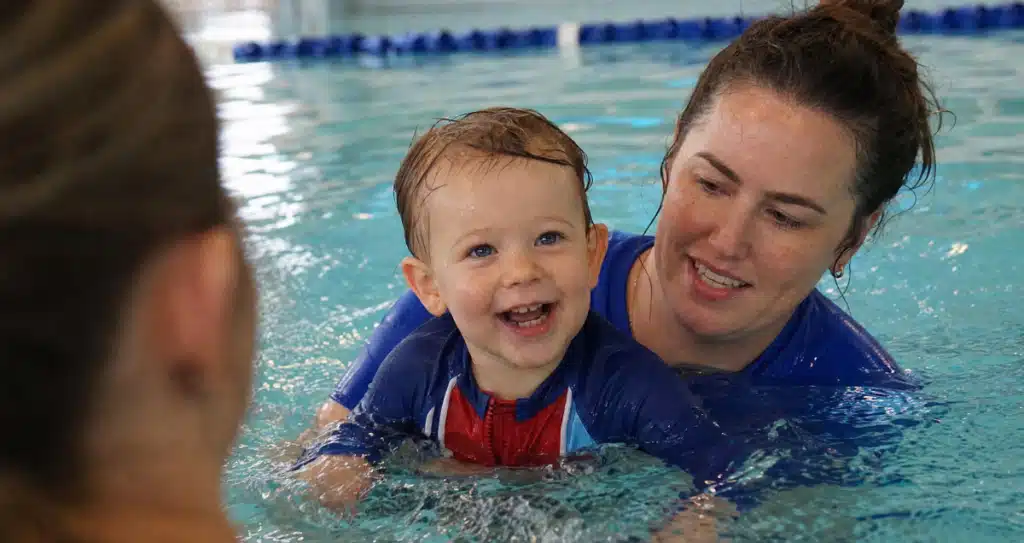
If you’re taking a baby or younger toddler to swimming lessons, there’s a very good chance you’ll be joining them in the water.
Parent or carer participation is common in early swimming programs because you’re the familiar person helping your child feel secure while they explore a completely new environment. The instructor will usually demonstrate how to hold and support them, then guide the class through activities together.
Depending on your child’s age, that could mean helping them kick, float, reach for toys, hold onto the pool edge, practise getting in and out of the water or simply become comfortable moving around in the pool.
With toddlers, there may be a little more independence involved. They might walk down the steps themselves, copy the instructor, attempt a skill with your support or enthusiastically announce that they can “DO IT MYSELF” while still holding tightly to your arm.
When children move into lessons without a parent varies between swim schools, programs and individual children, so it’s worth checking with your centre.
The important practical takeaway for that first lesson is simple: pack swimmers for yourself unless the swim school has specifically told you otherwise.
It sounds obvious once somebody says it. It is much less obvious when you’re standing poolside in jeans.
Sign up
Get tailored content based on your week of pregnancy
By signing up, you agree to receiving our Newsletters. Cancel anytime.


What actually happens in baby and toddler swimming lessons?
Early swimming lessons aren’t usually about teaching young children traditional swimming strokes straight away. They’re about building familiarity, confidence and foundational skills through play and repetition.
Your child might practise floating with support, kicking, paddling, blowing bubbles, holding onto the wall or moving towards you through the water. Lessons may also include songs, toys, simple games and activities that help children become comfortable with water around their face.
For toddlers, there may be more focus on following instructions, moving more independently, climbing in and out safely and beginning to understand simple water-safety behaviours.
Some children will throw themselves into every activity from the first minute. Others will spend several lessons carefully observing proceedings from the security of your shoulder.
Both are learning.
At this age, repetition is part of the process. The same pool, familiar teacher, repeated songs and predictable activities gradually help something new become something your child understands.
Will my baby or toddler be expected to go underwater?
This is often the question parents feel most nervous about.
Some swimming programs gradually introduce putting the face or head underwater as children become comfortable and ready. Early activities may start with splashing, pouring water gently over the body, blowing bubbles or practising a verbal cue before progressing towards brief submersion.
The exact approach varies between programs.
If you’re not sure what your instructor is asking you to do, ask them to explain it. A good teacher should be able to talk you through why they’re introducing a skill, what they’re looking for from your child and how you can support them.
Your child also doesn’t have to master every activity immediately. A toddler who happily splashes but strongly objects to putting their face in the water isn’t “behind”. A baby who needs more time to become comfortable isn’t failing the class.
Swimming lessons should build confidence around water gradually, not become a weekly test of bravery.
What should you bring to your child’s first swimming lesson?
Your swim school may have its own requirements, particularly around swim nappies or equipment, so check its instructions before your first class.
Generally, though, your bag will probably include:
- swimmers for your child and for you if you’re joining them
- an appropriate swim nappy if your child isn’t toilet trained, plus a spare
- a towel for each of you
- dry clothes and a fresh nappy or underwear for afterwards
- a wet bag or plastic bag for wet swimmers
- a drink bottle
- any feeding supplies or an age-appropriate snack you’ll need afterwards
- goggles if your older toddler uses them or the swim school recommends them
- an easy warm layer for after the lesson.
The first couple of lessons will quickly teach you what your family actually needs.
They’ll also teach you what you definitely don’t need, despite confidently packing it “just in case”.
Try not to overload yourself. You’ll already be carrying a bag, towels and a child who somehow becomes significantly more slippery the moment they leave the pool.
What should babies and toddlers wear in the pool?
Babies and toddlers can generally wear ordinary age-appropriate swimmers, but children who aren’t reliably toilet trained will usually need a swim nappy.
A regular disposable nappy isn’t designed for swimming because it absorbs pool water and becomes extremely heavy. Swim nappies are designed differently, but requirements can vary between centres.
Some swim schools accept disposable swim nappies, others prefer a reusable fitted style, and some may have their own specific policy.
It’s worth checking before the first lesson rather than discovering the rule while everybody else is already getting into the pool.
And take a spare.
If there is one universal law of parenting, it is that the likelihood of needing the spare rises dramatically the moment you decide you probably won’t.
Why arriving a little early makes the first lesson easier
Allow more time than you think you need, particularly for your first few lessons.
Around 10 to 15 minutes before class can give you enough breathing room to find parking, locate the change rooms, check in, work out where your class meets and get everyone changed without turning the arrival into an Olympic event of its own.
It can also give your child time to take in the environment.
Swimming pools are often noisy places. There’s splashing, whistles, voices bouncing off the walls and several classes happening at once. A toddler who happily jumps into a backyard pool may suddenly become cautious in a busy swim-school setting.
Let them watch for a few minutes. Point out the other children, the teacher or the toys in the water and give them time to process where they are before expecting them to join in.
Sometimes the gentlest introduction is simply not rushing.
How long do baby and toddler swimming lessons usually last?
Lesson length varies, but many classes for babies and toddlers run for around half an hour.
That can sound surprisingly short until you’ve spent 30 minutes lifting, holding, bouncing and encouraging a small child through water while enthusiastically participating in every song.
For young children, shorter lessons also make sense. Their attention and energy are limited, and the aim is to gradually build skills while keeping the experience positive.
Some weeks your child may happily participate until the end. Other weeks, they may decide at minute 17 that they have completed enough swimming for one lifetime.
That doesn’t mean the lesson was wasted.
Young children have tired days, hungry days, clingy days and days when absolutely nothing has gone according to plan since breakfast. Swimming lessons are no exception.
What if your baby or toddler cries or refuses to join in?
They might, particularly in the beginning.
The pool is unfamiliar, there’s a new instructor, the environment can be noisy and your child is being asked to do things with their body that feel completely new.
Some toddlers will refuse one activity and happily join the next. Some babies will cuddle into you for much of the lesson before gradually starting to watch what everyone else is doing.
Try not to judge the entire swimming experience by one difficult class.
Keep your own response calm, let the instructor know your child is new and give them permission to take things slowly. Sometimes watching from your arms for part of the lesson is exactly what they need before joining in.
If they remain distressed after several classes, talk with the teacher. A different lesson time, instructor, level or approach may suit your child better.
The goal isn’t to make them endure swimming lessons until they give up protesting. It’s to help them develop a comfortable relationship with water over time.
Does my toddler need to be confident in water before starting?
No. Building confidence is one of the reasons you’re there.
Children begin toddler swimming lessons with very different experiences of water. One child may have spent every summer in Grandma’s pool, while another may have barely experienced anything beyond a bath.
A good learn-to-swim program should work with the child in front of them.
If your toddler is particularly cautious, tell the instructor at the beginning. Knowing that your child likes to watch before joining in, doesn’t enjoy water on their face or takes a while to warm up to unfamiliar adults can help the teacher adjust their approach.
Confidence also doesn’t always look dramatic.
The child who goes from clinging to you for 30 minutes to standing on the pool step independently has made progress. So has the toddler who finally blows bubbles after refusing for four weeks.
Tiny changes count.
Food, feeds and snacks around swimming lessons
There isn’t one perfect feeding schedule that works for every baby or toddler.
Babies still need to feed according to their normal needs, and toddlers are generally more cooperative humans when they aren’t arriving at the pool desperately hungry.
You may find your child is happiest when they’ve eaten enough to be comfortable without having a particularly large meal immediately before a very active class. Your swim school may also have its own advice about timing.
If your baby has reflux, feeding difficulties or another health consideration, speak with their healthcare professional about what suits them.
And definitely think about afterwards.
Swimming seems to activate a very specific kind of toddler hunger where they emerge from a 30-minute lesson behaving as though they have crossed the English Channel. Having a snack or feed ready can make the trip home considerably more peaceful.
The post-swim change nobody really prepares you for
You finished the swimming lesson. Excellent.
Now comes the actual challenge.
You’re wet. Your child is wet. The floor is wet. Your toddler has decided clothing is an unreasonable social expectation, and the clean nappy you packed appears to have migrated to the very bottom of the bag.
The best approach is wonderfully unglamorous: make everything easy to reach.
Keep the dry clothes, towel and fresh nappy near the top of the bag. Have a wet bag ready. If there are family change rooms or change tables, find out where they are before the lesson.
It also helps to choose your own clothes with the post-swim situation in mind. This is not necessarily the morning for tight jeans, complicated buttons or anything requiring two uninterrupted hands.
Experienced swim parents can sometimes appear to get themselves and two children dressed in approximately six minutes.
They were not born with this gift. They have simply seen things.
Swimming lessons build skills, but they don't replace supervision
Swimming lessons are a valuable way for babies and toddlers to become more familiar with water and gradually develop swimming and water-safety skills.
But becoming confident in the pool is not the same as being safe around water.
Young children still need close, active adult supervision whenever they are in or around pools, beaches, baths and other bodies of water, regardless of how confidently they participate in their swimming lesson.
That’s especially worth remembering with toddlers, because their confidence can sometimes race ahead of their actual ability.
Swimming lessons are one part of water safety, alongside active supervision, safe barriers around pools and adults knowing how to respond in an emergency.
The goal isn’t to create a child who is somehow “waterproof”. It’s to help them build useful skills while the adults around them continue doing the important safety work.
Your child isn't the only beginner at their first swimming lesson
The first few swimming lessons are a learning curve for parents too.
You’re figuring out when to leave home, what belongs in the bag, whether your child likes the instructor, which songs apparently need to be sung every single week, and how to get everyone changed afterwards without leaving half your belongings at the pool.
It becomes easier.
Soon, you’ll know where to put the bag and which towel absolutely must remain dry. Your child will recognise the pool and perhaps start kicking their legs before you’ve even reached the water.
More importantly, you’ll begin noticing the little changes.
The cautious toddler who spent the first lesson glued to you starts reaching for a toy. Your baby relaxes into a float. The child who refused to get their face wet suddenly blows bubbles and looks extremely pleased with themselves.
Those moments are what early swimming lessons are really about.
There’s no need for your baby or toddler to become a confident swimmer overnight, and there’s no need for you to arrive looking like the parent who has done this a hundred times before.
Pack the swimmers, bring the spare nappy, give yourself more time than seems necessary and accept that somebody may cry.
It could even be you in the change room.
You’re both learning.
FAQs
What age can babies start swimming lessons?
Starting ages vary between swim schools and programs. Some offer parent-and-baby water familiarisation from infancy, while more structured learn-to-swim programs may begin later. Check the age requirements of your chosen program and speak with your child’s healthcare professional if you have questions specific to their health or development.
Do parents get in the pool during baby and toddler swimming lessons?
Parents or carers usually participate in baby swimming lessons and classes for younger toddlers. When children move into independent classes varies between swim schools, programs and individual readiness.
What should I bring to the first swimming lesson?
You’ll usually need swimmers for your child and yourself if you’re getting in, an appropriate swim nappy if required, towels, dry clothes, a spare nappy or underwear, a wet bag, water and any feeding or snack supplies you’ll need afterwards.
Does my toddler need goggles for swimming lessons?
Not necessarily. Some toddlers enjoy wearing goggles as their swimming develops, while others start without them. Your swim school can tell you whether they recommend goggles for your child’s class.
Will my baby or toddler go underwater during lessons?
Some programs gradually introduce brief submersion as children become comfortable and ready. The approach varies between swim schools, so ask your instructor how they introduce the skill and what cues they use.
What if my child cries at swimming lessons?
It can take time for babies and toddlers to become comfortable in a new pool environment. Keep things low-pressure, let them observe if they need to and talk with the instructor about ways to help them settle. If they continue to be very distressed across several lessons, it may be worth trying a different class, time or instructor.
How long are baby and toddler swimming lessons?
Many classes for babies and toddlers are around 30 minutes, although lesson length varies by provider and program.
Do swimming lessons make babies and toddlers safe around water?
No. Swimming lessons help children develop skills and confidence, but young children still need close, active adult supervision whenever they are in or around water.
Related Articles

Loved this article?
Share with a friend